
What belongs in a custom printed tape specification?
Specify roll width and length, material, logo dimensions, repeat distance, orientation, quantity per artwork and packaging unit. Review print appearance on the selected tape sample before approving production.
| Item | Specify before sampling | Check before production |
|---|---|---|
| Roll | Width in mm and length in m | Agreed dimensions and measurement method |
| Logo file, version, size, repeat and orientation | Physical printed sample on selected material | |
| Pack | Rolls per retail pack and quantity per design | Artwork version, barcode position and carton arrangement |
Keep print approval separate from any performance evaluation. See the supplier and document verification checklist.
A logo file is only one part of a printed tape order. A useful specification also identifies the tape material, finished roll width and length, print layout, quantity per design and retail packaging. Recording these choices together helps your purchasing team compare quotations on the same basis.
All products are made to order for OEM projects. Price, minimum order quantity and production schedule are confirmed according to the selected specification, packaging and order quantity. Sample quantity is confirmed for the selected product. Confirm the minimum quantity for each material, color and artwork combination in your quotation.
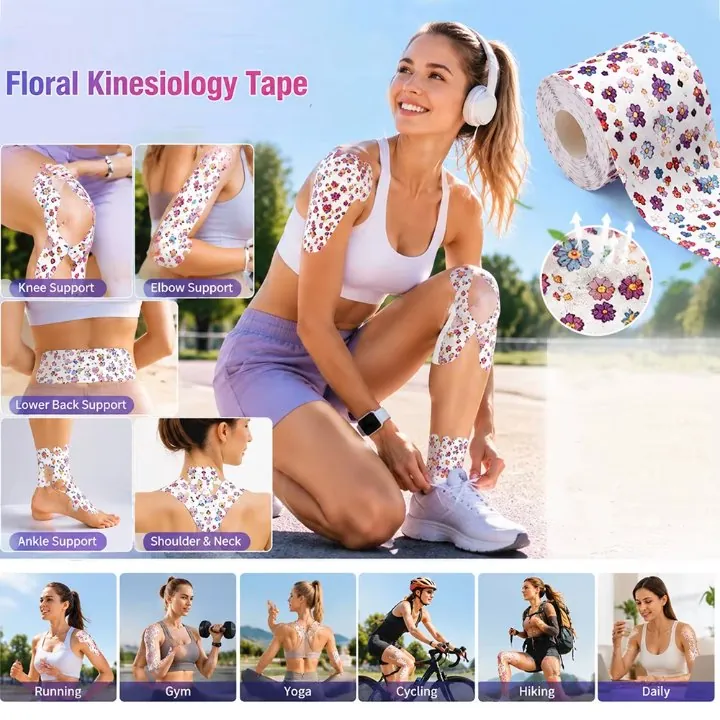
Choose a tape roll reference before preparing print artwork
Compare private label roll formats and separate cohesive-wrap references before finalizing your sample list.
A roll reference helps separate width, construction and artwork decisions. Ask for the print layout to be checked against the selected material and usable width; the references below do not establish that every design can be printed on every format.
| KT-03: custom-logo kinesiology tape rolls | Use the printed-roll reference to discuss logo placement, repeat distance, background color and the agreed roll size. Approve the printed sample and packaging together. |
|---|---|
| KT-18: 2.5 cm × 5 m narrow tape rolls | For a 25 mm wide roll, state the artwork dimensions in millimeters and ask which print area is feasible. A layout prepared for a wider roll should be checked again before sampling. |
| KT-23: 5 cm × 5 m porous cotton tape | Review the porous construction before approving the artwork. Discuss how the selected pattern and print placement relate to the openings, then confirm appearance on a physical sample. |
1. Specify material, width and roll length
Our standard listed format is 5 cm × 5 m. The catalogue also lists 2.5, 7.5 and 10 cm widths, plus 32 m bulk rolls. State the exact width and length you need; confirm availability for the chosen material and printed design instead of assuming that every option can be combined.
The listed cotton construction is 95% cotton and 5% spandex, with synthetic nylon and rayon options also available. Identify the requested construction and whether you need a solid, printed or punched version. Ask for the specification and sample of that exact option.
Keep units consistent. For example, 5 cm × 5 m can be written as 50 mm wide and 5 m long. A 1,000-roll order in that format contains 5,000 linear meters of finished tape. This is a quantity calculation, not a production-yield estimate or a quotation for raw material.
For ready-cut strips or shaped patches, use our pre-cut kinesiology tape range and specify the outline and dimensions separately. A roll specification does not define a pre-cut shape.
2. Describe how the logo repeats along the tape
Send the logo or pattern together with a layout showing its intended size, orientation and position across the roll. Include the distance between repeated logos, the tape background color and the colors used in the design. If the repeat is undecided, request a proposed layout before sample production.
- State whether the artwork should face one direction or alternate along the roll.
- Show the requested clear space around the artwork and any areas that should remain unprinted.
- Identify each design with a version name so the quotation and sample refer to the same file.
- Provide a physical color reference if color matching is important, and agree how the sample will be evaluated.
Mark dimensions as requests until the factory confirms the printable area and feasible repeat. Review the artwork on the chosen tape material: a screen preview alone cannot show the appearance of ink on a textured, elastic substrate.
3. Approve the roll and print together
Use a written sample checklist covering roll width, roll length, material, background color, logo size, orientation, repeat and liner removal. Compare the sample with the latest artwork version and record any differences that need correction.
Agree the measurement method and tolerances with the supplier, including the condition in which dimensions are checked. Review the printed appearance on the physical sample and discuss any additional evaluation needed for your intended product and market. Keep performance requirements separate from artwork approval.
Record the approved sample reference, artwork file and packaging version in the order documentation. If the material or design changes after approval, confirm whether another sample is needed and how it affects cost and timing.
4. Define the pack and the quotation unit
Listed packaging options include a single-roll box, a hang-tab bag, a six-roll retail pack and bulk packaging. Tell us whether your request is for a price per roll, per retail pack or per shipping carton. Include the number of rolls in each pack and the color or design assortment.
For example, 1,200 rolls packed six to a retail pack would make 200 retail packs. Confirm that the quantity per design and any packaging minimums are acceptable; this arithmetic does not establish a minimum order or a price.
Request the packaging dimensions or dieline before final artwork. Specify the barcode, roll dimensions, instruction language and any batch information required on the pack. Ask for the carton packing details, dimensions and weight needed to compare shipping quotations.
5. Copy this custom printed tape RFQ checklist
- Format: roll width in millimeters and length in meters.
- Construction: requested material and solid or punched version.
- Artwork: file version, logo size, orientation, repeat and colors.
- Quantity: rolls per material, background color and design; confirm the MOQ for each combination.
- Packaging: single-roll box, hang-tab bag, multi-roll pack or bulk; rolls per pack and artwork.
- Sample: dimensions, print and packaging checks; agreed tolerances and approval reference.
- Delivery: destination country, requested date and shipping terms.
- Quotation: unit basis, sample and artwork costs, packaging costs and confirmed lead time.
Request a printed kinesiology tape quotation
Review our kinesiology tape manufacturing options and OEM / ODM quotation process before submitting your specification.
Download a blank purchasing worksheet
Record the finished roll and physical print sample together. A screen preview does not approve the print on the selected tape construction.
Download printed tape roll rfq worksheet (TXT, English, 1.7 KB)Fill the worksheet locally and email the relevant specification to mz@mzbio.com, or copy its fields into the inquiry form. Confirm the final specification and commercial terms in the quotation.